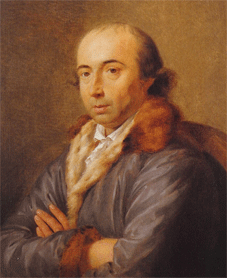
vom 31. August -3. September 2023 in Bückeburg
| Donnerstag, 31. August |
|
|
| Eröffnung |
|
|
| 14.30 |
Begrüßung durch die Veranstaltenden |
|
| Sektion 1 |
Bückeburg |
|
| 15.00 |
Martin Keßler |
Einführung: Herder und Bückeburg |
| 15.15 |
Stefan Brüdermann |
Graf Wilhelm zu Schaumburg-Lippe und sein kleiner ,Musenhof‘ |
| 16.00 |
Kaffeepause |
|
| 16.30 |
Vera Gretges |
Herder als „Lehrer der Religion“ – Einblicke in das Wirken des Oberpredigers in Bückeburg |
| 17.15 |
Rainer Godel |
Fragmentarische Denkmale. Herders Nekrolog auf Thomas Abbt |
| 19.30 |
Mitgliederversammlung der IHS |
|
| Freitag, 1. September |
|
|
| Sektion 2 |
Natur und Bibel |
|
| 9.00 |
Michael Maurer |
Morgenröte bei Herder |
| 9.45 |
Gianluca Paolucci |
Herders theologische Anthropologie in den Schriften zur Bibel und in den Predigten der Bückeburger Zeit |
| 10.30 |
Kaffeepause |
|
| 11.00 |
Heinrich Clairmont |
„ein […] weitstrahlsinniges Ganze, eine in der Fülle verschlungner Geschöpfsäste lebend und rollende Welt“ – zu Textgenese und -konstitution der Älteste[n] Urkunde des Menschengeschlechts |
| Sektion 3 |
Geschichtsphilosophie |
|
| 11.45 |
Liisa Steinby |
Formen des Wissens in Herders Geschichtsphilosophie |
|
| 14.00 |
Stadtführung durch Herders Bückeburg |
|
| 15.30 |
Catherine Girardin |
The metaphor of the world (history) as theatre inHerder’s Auch eine Philosophie der Geschichte zur Bildung der Menschheit (1774) |
| 16.15 |
Kaffeepause |
|
| 16.30 |
Hirohito Mita |
Zoroasters Sprache: Herders Philo-Logos in seiner Geschichtsphilosophie |
| 17.15 |
Kaspar Renner |
Harich versus Haym. Zum Deutungskonflikt über die politischen Implikationen von Herders Bückeburger Geschichtsphilosophie |
| ab 18.30 |
Empfang im Rathaus |
|
| Samstag, 2. September |
|
|
| Sektion 4 |
Bildungsimpulse |
|
| 9.00 |
Malte Nielsen |
In welchem Verhältnis stehen Bildungstheorie und -praxis in Herders Arbeiten der Bückeburger Zeit? |
| 9.45 |
Rainer Wisbert |
Philanthropismus und Humanismus. Herders Neuorientierung seines Bildungsdenkens in den Jahren 1772 bis 1776 |
| 10.30 |
Kaffeepause |
|
| 11.00 |
Johannes Schmidt |
Herder’s (Re-?)Orientation during the Bückeburg Years 1771-1776 — Becoming Maverick, Dissenter, and Individualist |
| 11.45 |
John Noyes |
Herders Lavater-Rezeption |
| Sektion 5 |
Dichtungen |
|
| 14.00 |
Shaun F. P. Hughes |
Herder and the Politics of Ossian |
| 14.45 |
Martin Blum |
"Die Erdbeeren" – Ein Gedicht von Johann Gottfried Herder aus der Bückeburger Zeit |
| 15.30 |
Kaffeepause |
|
| Sektion 6 |
Perspektiven |
|
| 16.00 |
Hannah Eldridge |
Thinking Race with Herder: Promise and Provokation |
| 16.45 |
Beate Allert |
How does diversity have a relevance from Herder's Bückeburg Contributions to the question what makes Epochenstil (style of an epoch)? |
| Abschluss |
|
|
| 18.30 |
|
Stadtkirche Bückeburg: Aufführung des Oratoriums Die Auferweckung des Lazarus |
| |
|
Text: Johann Gottfried Herder |
| |
|
Musik: Johann Christoph Friedrich Bach |
| |
|
Orchester Concerto ispirato, Kantoreien aus Bückeburg und Stadthagen |
| |
|
Leitung: Iris Maron |
| |
|
Einführung: Catherine Girardin |
| Sonntag, 3. September |
|
|
| 8.30 |
|
Abfahrt zum Besuch des fürstlichen Mausoleums in Stadthagen |
| 10.00 |
|
Festgottesdienst in der angrenzenden St. Martini-Kirche mit Landesbischof Dr. Karl-Hinrich Manzke |
| 12.00 |
|
Rückfahrt nach Bückeburg |
| |
|
|
| |
|
|
| |
|
|
| |
|
|
| |
|
|
| |
|
|
| |
|
|
| |
|
|
| |
|
|
| |
|
|
| |
|
|
| |
|
|
| |
|
|
| |
|
|
| |
|
|
|
back to top |
|
|